
Harvard Business Review published a study that should make every service business owner uncomfortable.
Companies that respond to a new lead within 5 minutes are 100 times more likely to make contact than companies that wait 30 minutes. Not 10% more likely. Not twice as likely. One hundred times.
Most plumbing companies respond in hours. Some don't respond at all.
I watched this play out in real time with a client. Good company. Solid reputation. Years in business. And they were quietly hemorrhaging revenue every single day because of a 6-hour average response time.
Here's what we built, what changed, and what the numbers looked like 30 days later.
The Problem (And Why It Was Invisible)
When I first talked to the owner, he didn't think he had a lead response problem. His phone was ringing. His inbox had inquiries. The pipeline looked fine.
But when we dug into the actual data, the picture was different.
The average time between a lead coming in and someone from the company making first contact was 6 hours and 12 minutes. On nights and weekends, it was worse. Some leads never got a response at all, buried under a pile of other messages.
His close rate on inbound leads was 23%.
On the surface, that doesn't sound catastrophic. But here's what that number means in practice: out of every 100 people who reached out to his company, 77 of them hired someone else. Or didn't hire anyone. Or gave up trying.
When you're in a competitive market, plumbing leads don't wait. A homeowner with a burst pipe isn't going to sit around for 6 hours hoping you call back. They're going to keep calling down the list until someone answers.
The owner was working hard. His team was working hard. But the system was set up to lose leads by default, and nobody had stopped to look at it.
The other thing nobody had measured: how many leads were coming in after hours. When we pulled the data, nearly 40% of new inquiries were hitting outside of 8 AM to 5 PM. Those were essentially going into a black hole.
This is the silent revenue leak I see in almost every service business I work with. The work is good. The reviews are good. But the front door is broken, and the owner has no idea.
The System We Built
We called it a Speed to Lead stack. Four components, each one handling a specific part of the failure.
Step 1: Instant Acknowledgment
The first problem was simple: people weren't hearing back fast enough.
We set up automated responses across every channel where leads were coming in. Web form submissions, Google Business Profile, Facebook, text messages. Any new inquiry gets a personal-sounding response within 60 seconds, every time, regardless of day or hour.
Not a generic "thanks for reaching out" message. A response that addresses what they asked about, confirms someone will follow up, and gives them a specific timeframe. Short, warm, and specific.
The goal isn't to close the job with the first message. The goal is to stop the bleed. When someone hears back from you in 47 seconds, they stop calling the next company on the list. You've bought yourself time.
Step 2: Smart Qualification
Once a lead is acknowledged, the system starts a qualification conversation.
This was important for the plumber specifically because not all leads are equal. Some are urgent (pipe burst, no hot water). Some are planned work (bathroom remodel, water heater replacement). Some are price shoppers who will waste an hour of your time before telling you they're getting three quotes.
The automated qualification asks a few questions: What's going on? Is this urgent or something you're planning? Where are you located? Have you had a chance to look at the issue yourself?
The answers feed directly into how the lead gets handled on the back end. Urgent issues get flagged for immediate callback. Planned work gets routed into a scheduling flow. And leads that look like low-probability price shoppers get a different follow-up sequence.
This alone saved the owner's team a significant amount of time. They stopped getting on the phone with people who weren't actually ready to hire.
Step 3: Automated Booking
For leads that qualify, the system offers to book a service call or estimate visit directly, without a human in the loop.
This was the piece the owner was most skeptical about. He thought customers wouldn't want to book with a bot. He thought they'd insist on talking to a person.
He was wrong.
A surprisingly large percentage of people, especially younger homeowners and people doing non-emergency work, prefer to just pick a time without the back-and-forth. They get a link, they pick a slot, they get a confirmation. Done.
For leads that do want to talk first, the system captures their availability and queues them for a callback with all the context already documented.
Step 4: The Follow-Up Loop
This was the piece nobody had been doing at all: consistent follow-up on leads that didn't immediately convert.
Before the system, if someone filled out a form and didn't book right away, they fell off the radar. Maybe someone remembered to call them back, maybe they didn't.
Now, every unconverted lead enters a follow-up sequence. Day 1, Day 3, Day 7. Each touchpoint is short and helpful, not pushy. Checking in, offering to answer questions, making it easy to book when they're ready.
About 30% of the eventual conversions came from this follow-up loop. These were leads that had gone cold, that everyone assumed were lost, that the system quietly converted over the following week.
30 Days Later: The Numbers
Here's what the data looked like at the one-month mark.
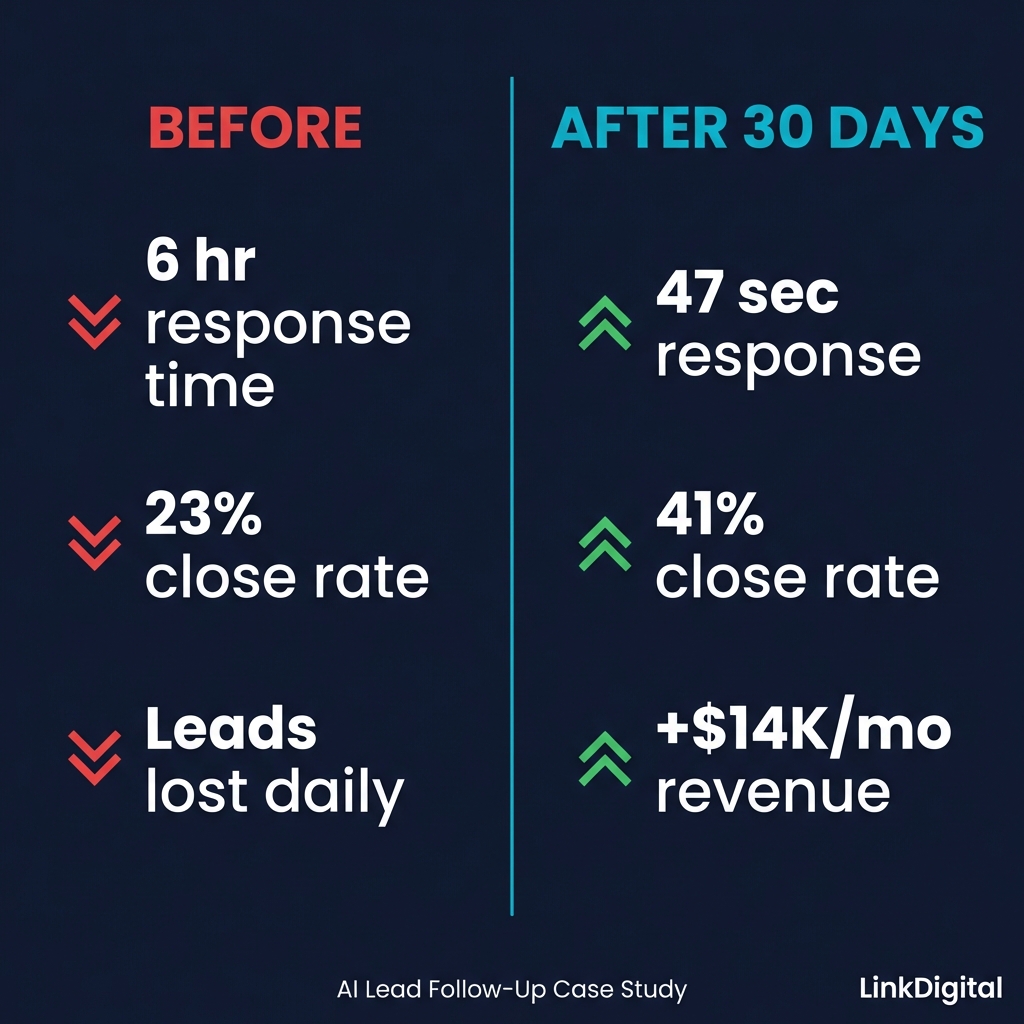
Response time: Down from 6 hours and 12 minutes to an average of 47 seconds.
Close rate: Up from 23% to 41%.
Revenue impact: The company added approximately $14,000 per month in revenue directly attributable to leads that would have previously gone cold or never gotten a response.
System cost: $1,800 per month, all-in, including the software, setup, and our ongoing management.
ROI: 7.8x in the first 30 days.
To put that in plain terms: for every dollar they spent on the system, they got $7.80 back. In month one. Before the system had even fully optimized.
The owner told me the thing that surprised him most wasn't the revenue number. It was the reviews. Several customers specifically mentioned in their Google reviews that they were impressed by how quickly someone got back to them. That responsiveness was becoming a competitive differentiator, not just a revenue driver.
What This Actually Means for Your Business
I want to be careful not to oversell this, because the numbers are real but they don't apply equally to every business.
The plumber's results were significant because the gap was large. A 6-hour response time is a massive leak. If your team is already responding in under an hour, the improvement will be smaller. If you're in a low-competition market, the urgency is different.
But here's what I'd encourage you to actually measure before assuming you don't have this problem:
What is your average response time right now? Not what you think it is. Not what your team says it is. Pull the actual data from your CRM or inbox and measure it.
What percentage of your leads never get a response? Look at your web form submissions and your missed calls from the last 60 days. How many of them got a follow-up?
What is your close rate on inbound leads? If you don't know this number, that's the first problem to fix.
In my experience, most service business owners think their response process is better than it actually is. The systems look fine from the inside. It's only when you measure the output that the leak becomes visible.
If you're at 6 hours, you're losing a lot. If you're at 2 hours, you're still losing some. The 5-minute window is where the real leverage is, and it's very hard to hit consistently without automation.
One more thing worth noting: this system doesn't replace your people. The plumber's team still handles every job. They still do the estimates. They still build the customer relationships. The automation just makes sure that the leads they work hard to generate actually get captured, qualified, and converted. It fills the gap that used to exist between "lead comes in" and "human picks up the phone."
That gap, when you're at a 6-hour average, is where your competitors are winning.
The Bigger Picture
There's a compounding effect here that doesn't show up in 30-day numbers.
A higher close rate means more revenue per marketing dollar spent. If you're already paying to generate leads, converting more of them is the most efficient growth lever you have. You don't have to spend more on ads. You just have to stop wasting the leads you're already getting.
And the reviews piece matters more than most owners think. A reputation for fast response time is hard for competitors to copy quickly. It becomes a moat.
If you want to dig into the lead response side of this more, this post on why AI lead response is a game-changer for small business covers the research and the mechanics in more depth. And if you're thinking about how systems like this affect the long-term value of your business, the connection between automation and business valuation is worth reading.
The bottom line: if you're running a service business and you don't know your average response time, that's the first number to go find. It might be fine. It might look like this plumber's did before we started measuring.
If you want to know what a Speed to Lead system would look like for your specific business, including the numbers on what you're likely leaving on the table right now, that's exactly what we talk through in a discovery call.
Book a call at linkdigital.io/book-a-call and we'll map it out together. No pitch, no pressure. Just an honest look at where the leak is and what it would take to fix it.
Want to implement AI in your business?
Book a free strategy session and we'll create a custom plan for your business.
Book a Free Call