
Everyone is talking about AI right now. Chatbots. Agents. Copilots. AI-powered this, AI-enhanced that.
And most small business owners I talk to are completely paralyzed by it. Not because they're slow or resistant to change. Because there's genuinely too much noise and not enough signal.
So nothing gets implemented. The phone still goes to voicemail. Leads still fall through the cracks. Revenue still leaks.
I built AI systems for my own business first. Brush Masters is a forestry mulching company that my business partner Pete runs on the ground in North Carolina. I'm a software engineer, so when I saw how many leads were slipping through, I started automating things. Not fancy things. Boring things.
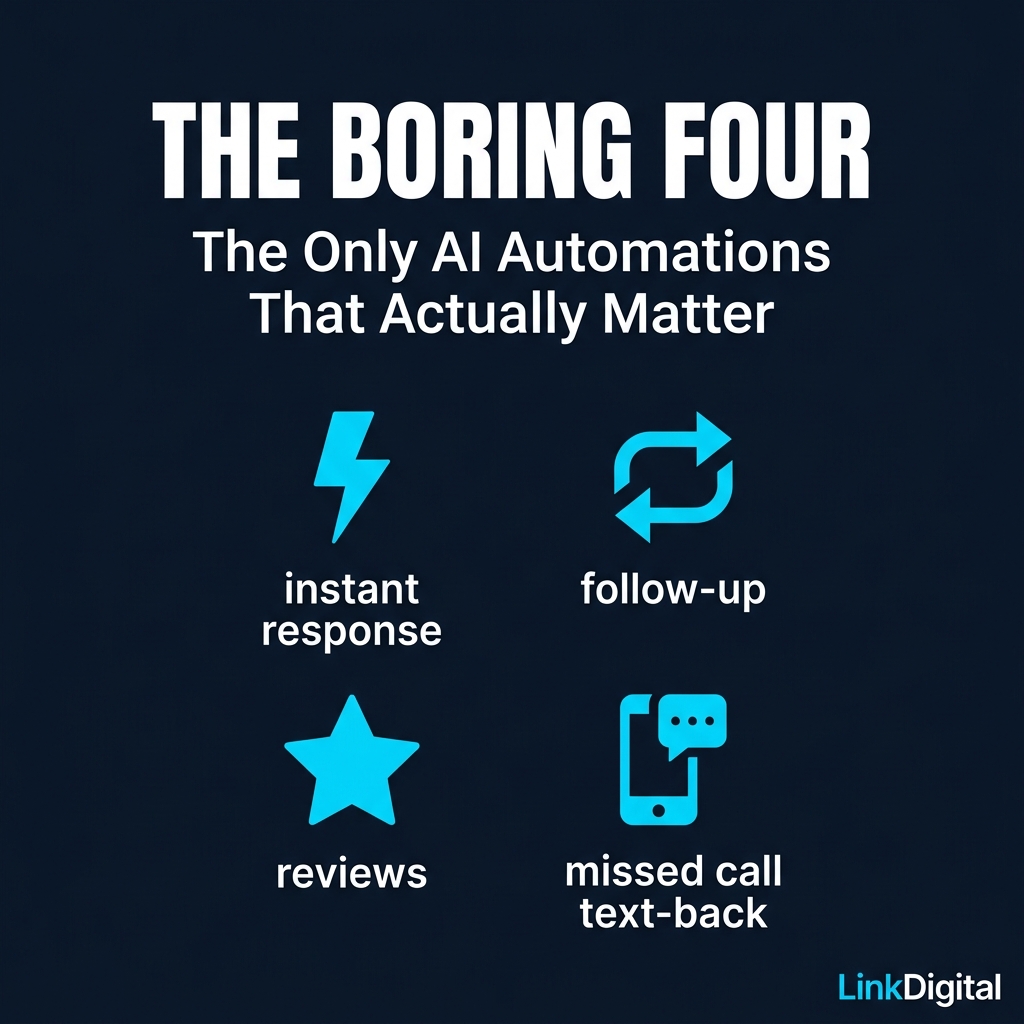
Those boring things changed the business. Now I help other service businesses do the same. And after working with dozens of them, I keep seeing the same pattern: there are exactly four automations that actually move the needle. Everything else is a distraction.
Here they are.
#1: Instant Lead Response
What it is: Any new lead that comes in, from any channel, gets an immediate response within 60 seconds. Facebook message, web form, Google Business inquiry, missed call, text. Doesn't matter. They hear back instantly.
Why it works: The research here is overwhelming. A study by MIT and InsideSales found that businesses responding to leads within 5 minutes are 100x more likely to make contact than businesses that wait 30 minutes. One hundred times. Wait an hour and you're essentially not competing.
Here's why that gap is so dramatic. When someone searches for a service, they don't call one business. They call two or three. The first one to respond wins the conversation. By the time you call back an hour later, they've already booked with your competitor.
The average small service business takes 47 hours to respond to a web lead. Not minutes. Hours. Two full days. That's not a slight disadvantage. That's losing every lead to whoever responds faster.
A simple example: When a new lead comes in through Brush Masters' website, an AI sends a text within 30 seconds: "Hey, this is Pete with Brush Masters. Got your message about clearing some land. Quick question, can you tell me roughly how many acres we're talking about?" It starts a conversation immediately, while the lead is still warm and their phone is still in their hand.
That one change alone improved our contact rate significantly. Not because we hired more people. Because we stopped making leads wait.
#2: Automated Follow-Up Sequences
What it is: After the first contact, leads who don't convert get automatically followed up with over the next 30-60 days through a structured sequence of texts, emails, or both.
Why it works: This one has a name in sales circles. The 80% rule. Research shows that 80% of sales require at least five follow-up contacts after the initial outreach. But 92% of salespeople give up after four attempts or fewer.
Read that again. Most sales don't happen until follow-up number five or beyond. And most businesses stop at one or two.
When someone doesn't respond to your first follow-up, it almost never means they're not interested. It usually means they're busy. Life got in the way. They meant to respond and forgot. They're getting three other quotes. A well-timed follow-up a week later catches them at a different moment.
A simple example: A roofing company gets a web lead. The AI sends an instant response. No reply. Three days later, it sends: "Just checking in. Still happy to come take a look at that roof." No reply. A week later: "We've got some openings next week if you'd like a free estimate." Still nothing? Two weeks after that: "Last chance to lock in our spring pricing before we fill up for the season."
That four-touch sequence running automatically in the background will convert leads that would have been written off as dead. Not every one. But enough to matter.
Most businesses put leads in a spreadsheet and forget them. Automated follow-up is how you stop leaving money on the table every single month.
#3: AI Review Requests
What it is: After a job is completed, an AI automatically sends a personalized review request at the optimal time, through the right channel, with the right message.
Why it works: Google reviews are the single most important trust signal for local service businesses. 93% of consumers say online reviews impact their buying decisions. The difference between a 4.1-star business and a 4.7-star business is not a small thing. It's often the difference between someone clicking on you or your competitor.
The problem isn't that your customers don't want to leave reviews. Most of them would be happy to. They just forget. Life moves fast. They paid the invoice, the job looks good, they move on. Two weeks later when you remember to ask, the moment has passed.
Timing and personalization are everything here. Asking for a review immediately after the job, when the customer is still in that moment of satisfaction, gets dramatically better results. Generic "please leave us a review" blasts get ignored. A message that references their specific job gets attention.
A well-timed, personalized review request system typically generates 3 to 5 times more reviews than asking manually or not asking at all.
A simple example: An HVAC company finishes a repair call. Two hours later, the customer gets a text: "Hey Sarah, glad we could get your AC back up and running today. If you have 60 seconds, a Google review would mean a lot to us. Here's the link: [link]." Not generic. Not a week later. Right now, while Sarah is still sitting in her cool house thinking about how relieved she is.
That specificity and timing is what separates a review request that converts from one that gets ignored. And over 12 months, the cumulative effect on your Google ranking is significant.
#4: Missed Call Text-Back
What it is: When someone calls and you can't answer, they get an automatic text within seconds: "Hey, missed your call. What can I help you with?"
Why it works: This is the easiest win on this entire list. It takes about 20 minutes to set up. And almost nobody does it.
Here's the thing about a missed call. The person calling you is at peak intent. They have a problem right now. They picked up the phone and called a business to solve it. When it goes to voicemail, 85% of them don't leave a message. They hang up and call the next number.
But a text is different. A text is conversational. It doesn't require them to formulate a whole message and leave it in a void. It opens a two-way dialogue that feels natural, and it happens instantly, before they have a chance to dial your competitor.
A simple example: Pete is on a job and can't answer the phone. Someone calls about getting brush cleared on their new property. The phone rings, goes to voicemail. Instantly, that caller gets a text: "Hey, missed your call. I'm out in the field right now. What can I help you with?" The caller responds. Now Pete has a lead in his texts that he can reply to when he has a free minute. No voicemail to listen to. No callback to schedule. A live conversation that already started.
That caller is also not calling your competitor because they're already texting you.
Why These Four and Nothing Else
There are 47 AI tools being pitched to small businesses right now. I'm not exaggerating. Scheduling AI, pricing AI, contract AI, proposal AI, social media AI, SEO AI, review AI, chatbots, voice bots, and on and on.
Most of them are interesting. Some of them are genuinely useful. But almost none of them solve a problem that costs you real money right now.
The Boring Four all have something in common: they directly attack revenue leaks that every service business has. A lead who doesn't hear back for 47 hours is a lost sale. A lead who got one follow-up and never heard from you again is probably a lost sale. A happy customer who never got asked for a review is a missed opportunity that compounds every month. A caller who got voicemail and no text is probably already booked with your competitor.
These are not marginal improvements. Fix all four and most service businesses are looking at a 20-40% improvement in lead conversion from the same volume of inbound interest. No more ad spend. No more cold outreach. Just capturing more of what's already coming in.
The Order Matters
This is important. Do them in this sequence.
Start with instant lead response. It's the highest leverage change you can make and the payoff is immediate. Every lead you're getting right now starts converting at a higher rate.
Then add follow-up sequences. Once you're catching more leads upfront, you need a system to nurture the ones who don't convert immediately. That's most of them.
Then missed call text-back. This is fast to set up and pairs perfectly with your lead response system. Any call you miss gets pulled into the same follow-up pipeline.
Then review requests. Once your response and follow-up systems are running, you can layer in review automation to start building your Google presence over time.
Build in this order because each one lays the foundation for the next. If you skip ahead and set up review automation before your lead response is solid, you're optimizing the wrong end of the funnel.
One More Thing
I'm not selling you on some expensive software platform or a six-month implementation project. These four systems can be running in most service businesses within a few weeks.
But the first step is knowing which one will move the needle most for your specific situation. A landscaping company with 200 missed calls per month has a different priority than a law firm that answers every call but never follows up.
If you want to figure out where your biggest leak is, I offer a free AI audit call. It's 30 minutes. We look at your current setup, run some numbers, and tell you exactly which of the four to start with and what that could realistically mean for your revenue.
No pitch. No pressure. Just a straight assessment of where you're leaving money on the table and what to do about it.
Want to implement AI in your business?
Book a free strategy session and we'll create a custom plan for your business.
Book a Free Call